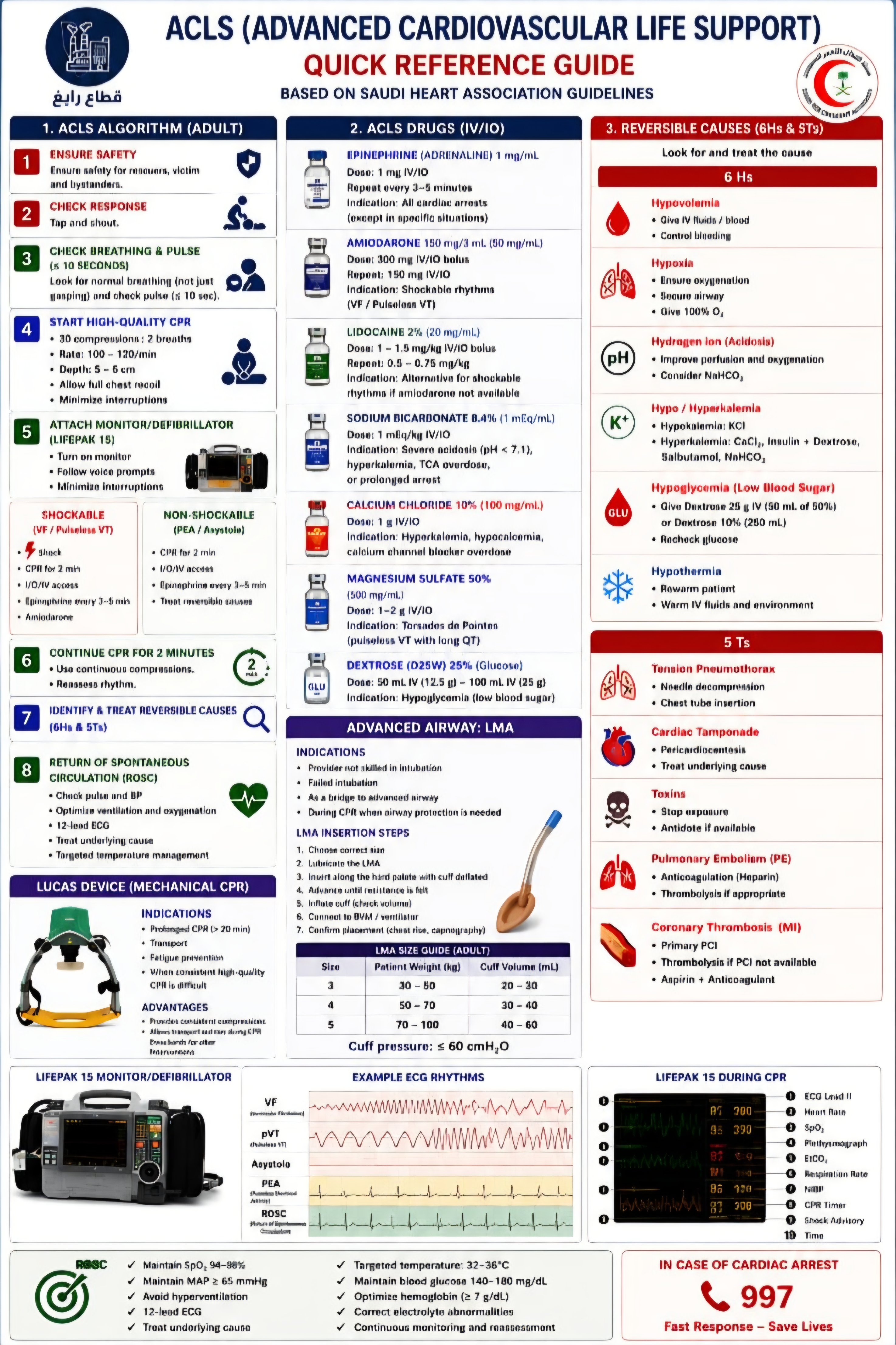
CPR STEPS (Adult)
1
SAFETY
Ensure scene safety.
2
CHECK RESPONSE
Tap and shout.
3
CALL FOR HELP & GET AED
Activate emergency response system and get AED.
4
CHECK BREATHING & PULSE (≤ 10 seconds)
If no normal breathing or no pulse → start CPR.
5
START HIGH-QUALITY CPR
- 30 compressions : 2 breaths
- Rate: 100–120/min
- Depth: 5–6 cm
- Allow full chest recoil
- Minimize interruptions
If not trained or unable to give breaths:
Continuous compressions 100–120/min
6
ATTACH AED ASAP
- Turn on AED and follow prompts
- Minimize interruptions
RHYTHM
SHOCKABLE (VF / Pulseless VT)
- Give 1 shock
- Resume CPR immediately for 2 minutes
RHYTHM
NON-SHOCKABLE (PEA / Asystole)
- Resume CPR immediately for 2 minutes
- No shock
7
ADVANCED AIRWAY
- If needed and trained
- Prefer advanced airway (ETT or LMA)
- Continuous waveform capnography
- Confirm tube/LMA position
8
GIVE MEDICATIONS
- Epinephrine as soon as possible
- Repeat every 3–5 minutes
- Amiodarone for shockable rhythm
9
IDENTIFY & TREAT REVERSIBLE CAUSES
Think Hs & Ts (see reversible causes panel).
10
RETURN OF SPONTANEOUS CIRCULATION (ROSC)
- Check pulse, BP, SpO2
- Support ventilation and oxygenation
- 12-lead ECG and treat cause
- Targeted temperature management
HIGH-QUALITY CPR KEY POINTS
- Push hard (5–6 cm)
- Push fast (100–120/min)
- Full chest recoil
- Minimize interruptions (<10 sec)
- Avoid excessive ventilation
ACLS DRUGS
EPINEPHRINE (Adrenaline)
- Dose
- 1 mg IV/IO
- Repeat
- Every 3–5 minutes
- Indication
- All cardiac arrests (except in specific situations)
AMIODARONE
- Dose
- 300 mg IV/IO bolus
- Repeat
- 150 mg IV/IO
- Indication
- Shockable rhythms (VF / Pulseless VT)
LIDOCAINE (Alternative)
- Dose
- 1–1.5 mg/kg IV/IO bolus
- Repeat
- 0.5–0.75 mg/kg
- Indication
- Shockable rhythms (if amiodarone not available)
SODIUM BICARBONATE
- Dose
- 1 mEq/kg IV/IO
- Indication
- Consider in severe acidosis, hyperkalemia, TCA overdose, or prolonged arrest
CALCIUM CHLORIDE (10%)
- Dose
- 1 g IV/IO
- Indication
- Hyperkalemia, hypocalcemia, calcium channel blocker overdose
MAGNESIUM SULFATE
- Dose
- 1–2 g IV/IO
- Indication
- Torsades de pointes (pulseless VT with long QT)
ADVANCED AIRWAY: LMA
WHEN TO USE LMA
- Provider not skilled in intubation
- Failed intubation
- As a bridge to advanced airway
- During CPR when airway protection is needed
LMA INSERTION STEPS
- Choose correct size
- Lubricate the LMA
- Insert along the hard palate with cuff deflated
- Advance until resistance is felt
- Inflate cuff (check volume)
- Connect to BVM / ventilator
- Confirm placement:
- Chest rise
- Capnography waveform
- Equal air entry
| Size | Patient Weight |
|---|---|
| 3 | 30–50 kg |
| 4 | 50–70 kg |
| 5 | 70–100 kg |
| Limiting pressure: < 60 cmH2O | |
REVERSIBLE CAUSES (Hs & Ts)
Look for and treat the cause
6 Hs
HHYPOVOLEMIA
- Give IV fluids / Blood
- Control bleeding
HHYPOXIA
- Ensure oxygenation
- Secure airway
- Give 100% O2
HHYDROGEN ION (ACIDOSIS)
- Improve perfusion and oxygenation
- Consider NaHCO3
HHYPO / HYPERKALEMIA
- Hypokalemia: KCl
- Hyperkalemia: CaCl2, Insulin + Dextrose, Salbutamol, NaHCO3
HHYPOTHERMIA
- Rewarm patient
- Warm IV fluids and environment
HHYPOGLYCEMIA
- Check blood glucose
- Give IV Dextrose
5 Ts
TTENSION PNEUMOTHORAX
- Needle decompression
- Chest tube insertion
TCARDIAC TAMPONADE
- Pericardiocentesis
- Treat underlying cause
TTOXINS
- Stop exposure
- Antidote if available
TPULMONARY THROMBOSIS
- Anticoagulation (Heparin)
- Thrombolysis if appropriate
TCORONARY THROMBOSIS
- Primary PCI
- Thrombolysis if PCI not available
- Aspirin + Anticoagulant